
AGNIDEEP.IN
DETAILED INFORMATION OF DIFFERENT TYPES OF HAVAN
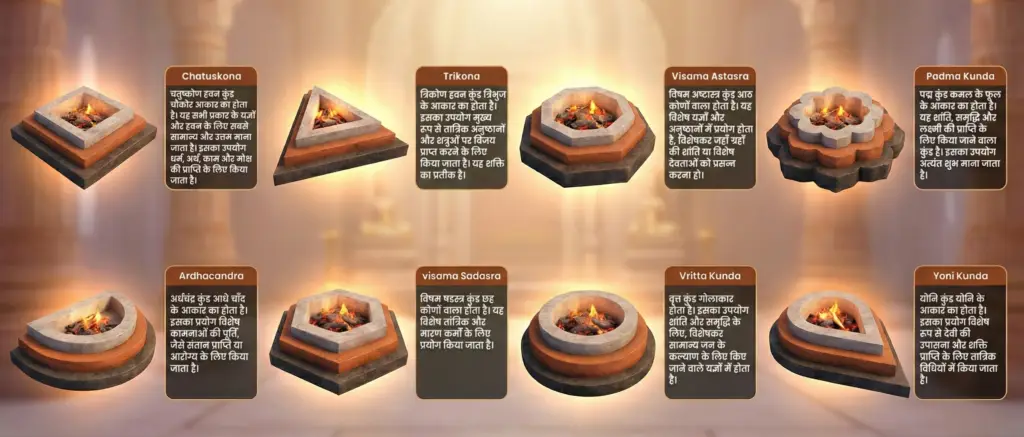
Based on the image you provided, this is a page from a text regarding Vastu Shastra or Vedic Rituals (Karmakanda). It details specific types of Havan Kundas (Sacrificial Fire Pits).
In Hindu Vedic tradition, the shape of the fire pit is not arbitrary; each geometric form is strictly prescribed for specific goals, desires, or types of energy invocation. These are constructed with specific measurements and usually have three steps or tiers (called Mekhalas), which are clearly visible in your image.
Here is the detailed information on the specific Kundas shown in the image, reading from the standard Sanskrit meanings associated with these shapes:
1. Catuskona (Square Kunda)
-
Shape: Square (
Catus= Four,Kona= Angle). -
Purpose: This is the most common and universal type of Kunda. It is used for general welfare, worldly desires, and peace.
-
Significance: It represents stability and balance. It is typically used for daily Agnihotra or general Havan rituals seeking Dharma (righteousness), Artha (wealth), Kama (desire), and Moksha (liberation).
2. Trikona (Triangular Kunda)
-
Shape: Triangle (
Tri= Three). -
Purpose: Used for victory over enemies or rituals involving intense energy (often associated with Tantric practices).
-
Significance: The triangle represents fire (Agni) itself. In Vastu and ritual texts, this shape is used for Abhichara Karma (rituals to defeat rivals) or to overcome severe obstacles.
3. Vritta Kunda (Circular Kunda)
-
Shape: Circle (
Vritta= Round). -
Purpose: Used for public welfare, peace, and health.
-
Significance: The circle has no beginning or end, symbolizing the universe. It is famously used in large-scale yajnas meant to bring peace to a nation or community, or for maintaining general health.
4. Ardhacandra (Semi-Circular Kunda)
-
Shape: Half-Moon or Semi-circle (
Ardha= Half,Chandra= Moon). -
Purpose: Used for family harmony, resolving domestic trouble, and happiness.
-
Significance: The moon governs the mind and emotions. A Kunda in this shape is believed to cool heated tempers within a family and bring emotional stability.
5. Yoni Kunda (Yoni/Leaf Shaped)
-
Shape: Resembles a Pipal leaf, a heart, or the Yoni (womb).
-
Purpose: Used for progeny (having children) and curing difficult diseases.
-
Significance: This shape represents the source of creation and birth. It is specifically prescribed for couples seeking to conceive or for rituals aimed at curing ailments related to the body.
6. Padma Kunda (Lotus Kunda)
-
Shape: Lotus flower (
Padma= Lotus). -
Purpose: Used for accumulation of great wealth and abundance (Lakshmi).
-
Significance: The Lotus is the seat of Goddess Lakshmi (Wealth). Performing Havan in a lotus-shaped pit is believed to attract financial prosperity and material abundance.
7. Visama Sadasra (Hexagonal Kunda)
-
Shape: Six-sided (
Sad= Six,Asra= Corners/Sides). -
Purpose: Used for stopping enemies and preventing death/danger.
-
Significance: The hexagon is often associated with Lord Kartikeya (who has six faces) or protection. It is used to create a shield against negativity.
-
Note on the text: “Visama” usually implies “irregular” or “uneven,” suggesting the sides may not be equilateral in this specific diagram, but the ritual purpose remains connected to the six-sided form.
-
8. Visama Astasra (Octagonal Kunda)
-
Shape: Eight-sided (
Asta= Eight). -
Purpose: Used for health, comfort, and relief from suffering.
-
Significance: The number eight corresponds to the eight directions (Dikpalas). This Kunda is often used to bring all-around wellbeing and health to the performer.
Summary Table
| Kunda Name | Shape | Primary Spiritual Use |
| Catuskona | Square | General Success, Peace |
| Trikona | Triangle | Victory over Enemies |
| Vritta | Circle | Public Welfare, Peace |
| Ardhacandra | Half-Moon | Family Harmony |
| Yoni | Leaf/Womb | Progeny (Children), Health |
| Padma | Lotus | Wealth (Lakshmi) |
| Sadasra | Hexagon | Protection, Stopping Enemies |
| Astasra | Octagon | Health, Comfort |
A Note on Construction (Mekhalas)
If you look closely at the drawings, each Kunda has layers or steps surrounding the center. These are called Mekhalas (Girdles).
-
Standard Kundas usually have 3 Mekhalas.
-
They represent different cosmic principles (often White, Red, and Black colors are used to represent Sattva, Rajas, and Tamas gunas).
Would you like to know the specific measurements or directional placement (Vastu) required for any one of these Kundas?
IN HINDI:
आपने जो चित्र साझा किया है, वह हवन कुंडों (Havan Kundas) के विभिन्न प्रकारों को दर्शाता है। भारतीय वैदिक परंपरा और वास्तु शास्त्र में, हवन कुंड का आकार मनमाना नहीं होता; हर आकार का एक विशेष महत्व और विशिष्ट उद्देश्य होता है।
यहाँ चित्र में दिखाए गए हवन कुंडों की विस्तृत जानकारी हिंदी में दी गई है:
1. चतुष्कोण (Catuskona – चौकोर कुंड)
-
आकार: वर्गाकार (Square)।
-
उद्देश्य: यह सबसे सामान्य और सर्वव्यापी कुंड है। इसका उपयोग सामान्य कल्याण, शांति और धर्म-अर्थ-काम-मोक्ष की प्राप्ति के लिए किया जाता है।
-
महत्व: यह संतुलन का प्रतीक है। दैनिक अग्निहोत्र या सामान्य पूजा-पाठ के लिए इसी कुंड का प्रयोग सबसे उत्तम माना जाता है।
2. त्रिकोण (Trikona – त्रिभुजाकार कुंड)
-
आकार: त्रिभुज (Triangle)।
-
उद्देश्य: इसका प्रयोग मुख्य रूप से शत्रु पर विजय प्राप्त करने के लिए किया जाता है।
-
महत्व: यह अग्नि तत्व का प्रतीक है। इसका उपयोग अक्सर तांत्रिक क्रियाओं में या शत्रुओं की बाधाओं को दूर करने (अभिचार कर्म) के लिए किया जाता है।
3. वृत्त कुंड (Vritta Kunda – गोलाकार कुंड)
-
आकार: गोल (Circle)।
-
उद्देश्य: इसका उपयोग लोक कल्याण, सार्वजनिक शांति और स्वास्थ्य के लिए किया जाता है।
-
महत्व: वृत (गोला) का न कोई आदि है न अंत, यह ब्रह्मांड का प्रतीक है। बड़े महायज्ञों में, जहाँ उद्देश्य “विश्व शांति” हो, वहां गोलाकार कुंड बनाए जाते हैं।
4. अर्धचंद्र (Ardhacandra – अर्धचंद्राकार कुंड)
-
आकार: आधा चाँद (Semi-circle)।
-
उद्देश्य: इसका प्रयोग पारिवारिक सुख-शांति और गृह क्लेश को दूर करने के लिए किया जाता है।
-
महत्व: चंद्रमा मन और भावनाओं का कारक है। माना जाता है कि इस कुंड में हवन करने से परिवार में प्रेम बढ़ता है और आपसी मनमुटाव शांत होते हैं।
5. योनि कुंड (Yoni Kunda)
-
आकार: पान के पत्ते जैसा या योनि आकार।
-
उद्देश्य: इसका उपयोग विशेष रूप से संतान प्राप्ति (पुत्र-पुत्री) और असाध्य रोगों के निवारण के लिए किया जाता है।
-
महत्व: यह सृजन (Creation) का प्रतीक है। जिन दंपत्तियों को संतान की चाह होती है, उनके लिए शास्त्रों में इस कुंड का विधान बताया गया है।
6. पद्म कुंड (Padma Kunda – कमल के फूल जैसा)
-
आकार: कमल का फूल (Lotus shape)।
-
उद्देश्य: इसका प्रयोग अखंड धन और लक्ष्मी प्राप्ति के लिए किया जाता है।
-
महत्व: कमल माँ लक्ष्मी का आसन है। आर्थिक संपन्नता और दरिद्रता को दूर करने के लिए पद्म कुंड में हवन करना बहुत शुभ माना जाता है।
7. विषम षडास्र (Visama Sadasra – षट्कोण कुंड)
-
आकार: छह कोने वाला (Hexagonal)।
-
उद्देश्य: इसका उपयोग शत्रुओं को रोकने (स्तम्भन) और सुरक्षा के लिए किया जाता है।
-
महत्व: छह कोने भगवान कार्तिकेय और सुरक्षा कवच से संबंधित माने जाते हैं। यह नकारात्मक शक्तियों को रोकने में मदद करता है।
8. विषम अष्टास्र (Visama Astasra – अष्टकोण कुंड)
-
आकार: आठ कोने वाला (Octagonal)।
-
उद्देश्य: इसका प्रयोग रोगी को स्वास्थ्य लाभ और कष्ट निवारण के लिए किया जाता है।
-
महत्व: आठ कोने आठों दिशाओं (दिग्पालों) का प्रतिनिधित्व करते हैं। यह कुंड सर्वत्र आरोग्य और सुख प्रदान करने वाला माना जाता है।
सारांश तालिका (Summary Table)
| कुंड का नाम | आकार | मुख्य उपयोग/उद्देश्य |
| चतुष्कोण | चौकोर (Square) | सामान्य सिद्धि और शांति |
| त्रिकोण | त्रिभुज (Triangle) | शत्रु विजय (Tantric use) |
| वृत्त | गोल (Circle) | जन कल्याण और विश्व शांति |
| अर्धचंद्र | आधा चाँद (Half-Moon) | पारिवारिक सुख और शांति |
| योनि | पत्ता/योनि (Leaf-shaped) | संतान प्राप्ति और रोग मुक्ति |
| पद्म | कमल (Lotus) | धन और लक्ष्मी प्राप्ति |
| षडास्र | छह कोने (Hexagon) | सुरक्षा और शत्रु स्तम्भन |
| अष्टास्र | आठ कोने (Octagon) | स्वास्थ्य और कष्ट निवारण |